
The SAP ABAP certification exam is designed to validate a candidate’s ability to develop, enhance, and maintain applications within SAP systems using Advanced Business Application Programming (ABAP). Unlike functional SAP certifications that focus on business processes and configuration, ABAP certification targets technical proficiency at the code and system-interaction level.
ABAP developers play a critical role in extending SAP standard functionality, integrating custom logic, and supporting enterprise-specific requirements. As SAP landscapes evolve with S/4HANA and cloud-based deployments, the certification exam has shifted its focus toward modern ABAP concepts, performance-aware coding, and clean-core principles. This makes the exam relevant not only for legacy system developers but also for those working on newer SAP platforms.
Technical Purpose of the SAP ABAP Certification Exam
The SAP ABAP certification exam exists to confirm that a developer can write reliable, efficient, and maintainable ABAP code within enterprise SAP environments. It tests how well candidates understand SAP’s programming model rather than how quickly they can recall syntax.
The exam evaluates whether a candidate can:
- Build ABAP programs aligned with SAP standards
- Work effectively with data dictionary objects
- Understand execution flow within SAP systems
- Apply object-oriented ABAP principles
- Optimize performance and resource usage
This focus separates professional developers from script-level coders.
How ABAP Certification Differs From Functional SAP Exams
Functional SAP ABAP exams test configuration logic and business process alignment. ABAP certification exams, by contrast, focus on technical implementation and system behavior.
Key differences include:
- Emphasis on programming logic rather than business rules
- Evaluation of code structure and modularity
- Focus on database interaction and performance
- Assessment of error handling and debugging
Candidates must think like developers, not consultants.
Core Knowledge Areas Covered in the Exam
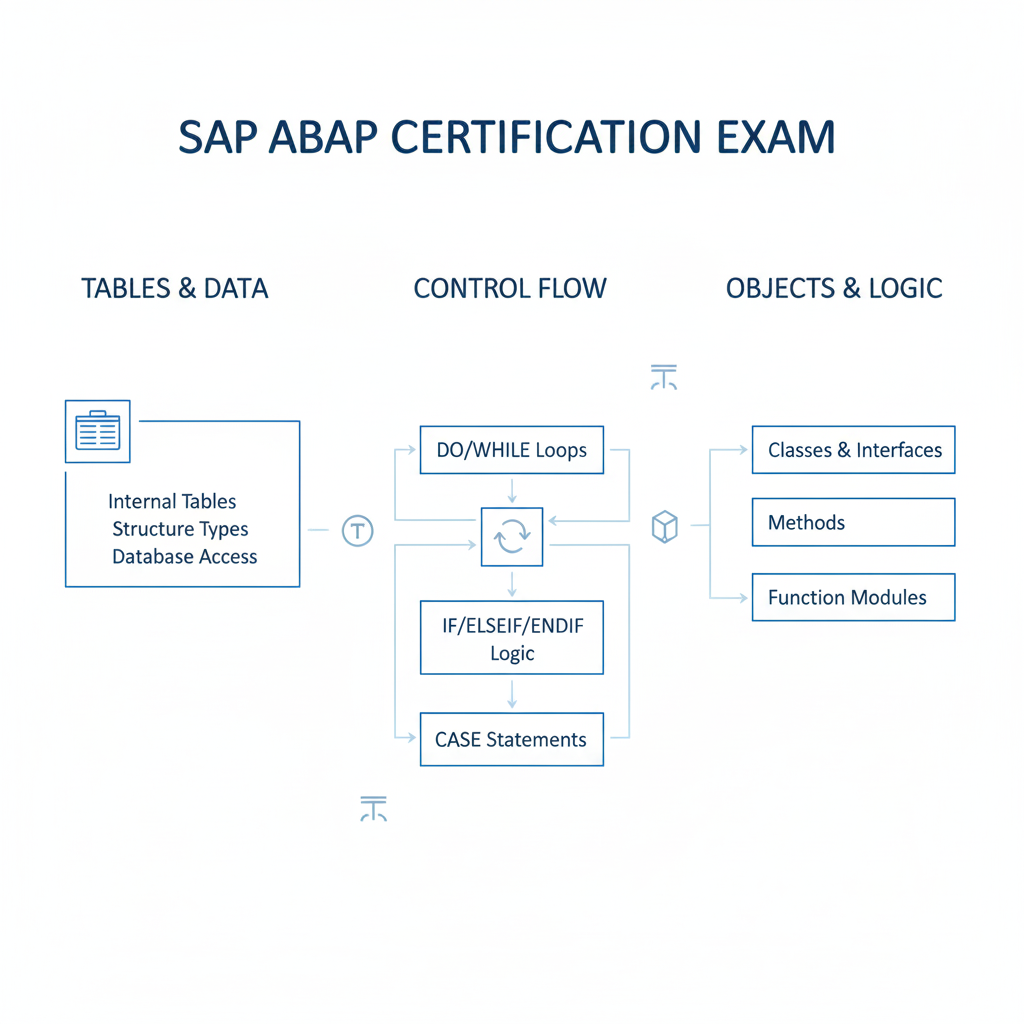
The SAP ABAP certification exam spans multiple technical domains. Questions are designed to assess both foundational knowledge and applied understanding.
Primary areas include:
- ABAP syntax and program flow
- Data Dictionary concepts
- Internal tables and data processing
- Modularization techniques
- Object-oriented ABAP
- Database access and Open SQL
Each area contributes to real-world development capability.
Object-Oriented ABAP in Certification Context
Modern ABAP certification places strong emphasis on object-oriented programming concepts. Candidates are expected to understand how OO principles apply within SAP systems.
Exam questions often assess:
- Class and interface design
- Inheritance and polymorphism
- Encapsulation of logic
- Reusability and maintainability
Understanding why OO design is used matters more than memorizing syntax.
Performance Awareness and Database Interaction
ABAP developers must write code that performs efficiently in large enterprise systems. The certification exam reflects this reality.
Performance-related concepts include:
- Efficient internal table operations
- Proper use of Open SQL
- Avoiding unnecessary database access
- Understanding execution context
Candidates who ignore performance considerations often struggle with scenario-based questions.
The topic was also addressed in Cert Empire’s X (Twitter) post, offering quick insights.
Understanding SAP Execution Context
ABAP code does not run in isolation. The exam tests awareness of how programs interact with SAP system components.
Key concepts include:
- Work processes
- Dialog vs background execution
- Authorization checks
- Update tasks and commits
This system-level understanding distinguishes experienced developers.
Comparing Strong and Weak ABAP Exam Preparation
| Preparation Focus | Resulting Skill Level | Exam Outcome |
|---|---|---|
| Syntax memorization | Limited | Inconsistent |
| Conceptual understanding | Strong | Reliable |
| Performance-aware coding | Advanced | High accuracy |
| System interaction awareness | Professional | Exam-ready |
This comparison highlights the importance of depth over memorization.
Typical Challenges Faced by ABAP Candidates
Even experienced developers encounter difficulties during certification preparation.
Common challenges include:
- Underestimating object-oriented questions
- Overlooking performance implications
- Confusing legacy and modern ABAP practices
- Misinterpreting scenario-based questions
Awareness of these issues helps candidates adjust their preparation strategy.
Role of Practice Questions for ABAP Exams
Practice questions help developers adapt to exam-style thinking, especially when scenarios test judgment rather than syntax.
Some candidates refer to platforms like Cert Empire when looking for SAP ABAP certification practice material that mirrors real exam logic and emphasizes reasoning over rote coding.
The value lies in explanation quality, not question quantity.
How the ABAP Certification Supports Career Growth
The SAP ABAP certification exam supports professional credibility in technical SAP roles. It validates that a developer understands SAP programming standards and can contribute to enterprise-scale systems.
Professionals often benefit through:
- Increased trust in development decisions
- Eligibility for senior developer roles
- Stronger collaboration with functional teams
- Better alignment with SAP modernization initiatives
Certification complements experience rather than replacing it.
Relevance in S/4HANA and Modern SAP Landscapes
ABAP remains central to SAP development, even as platforms evolve. The certification reflects modern expectations, including clean-core concepts and extensibility models.
Candidates should understand:
- Adaptations vs modifications
- Future-proof development approaches
- Integration with SAP Fiori and services
This ensures long-term relevance.
Preparation Approach for Technical Candidates
Effective preparation focuses on strengthening conceptual clarity and reviewing real-world scenarios rather than memorizing commands.
Productive preparation habits include:
- Revisiting core ABAP principles
- Reviewing performance guidelines
- Practicing scenario interpretation
- Analyzing explanation-driven questions
This approach supports consistent exam performance.
Closing Perspective
The SAP ABAP certification exam validates more than programming ability. It confirms a developer’s understanding of how code behaves within SAP systems, how performance impacts enterprise operations, and how modern ABAP principles support long-term maintainability. Candidates who approach the exam with a system-aware, concept-driven mindset are best positioned to succeed and apply their skills confidently in real SAP environments. The topic is also discussed thoroughly in an earlier YouTube video.

